Which strategy to choose
What Winning at Plinko Actually Means
Before comparing systems, define the terms precisely, because most Plinko confusion comes from mixing up a return with a profit. In this guide a loss means the payout is below the stake, a profit means the payout is above the stake, and a break-even result exactly returns the stake and holds any progression in place. That definition matters because Plinko, unlike roulette, pays partial amounts constantly. On the Normal risk level the centre pocket pays 0.3 times the stake, on Low it pays 0.5, and on High only 0.2. Staking 1 FUN and landing centre on High returns 0.2 FUN: you received money back, yet you lost 0.8 FUN. Any system that treats every return as a win will mislead you from the first drop.
A concrete worked example makes this clear. Suppose you stake 10 FUN on Normal risk. The ball lands in a pocket paying 0.5x. Your payout is 5 FUN, your net result is minus 5 FUN, and your bank falls from 1000 to 995 FUN. The game displays a payout, which feels like a win, but the ledger shows a loss. Every system described below is evaluated against net results, not against whether any credit came back. You can explore how each pocket pays on the Plinko odds and payout table page before risking anything.
- Loss: payout below stake, even if some FUN is returned.
- Profit: payout above stake; only then do win-progression systems advance.
- Break-even: payout equals stake; progression holds without advancing or resetting.
10 betting systems
Systems One and Two: Fixed Stake and Percentage of Bank
The fixed stake system bets the same amount on every drop regardless of outcomes. It is the baseline against which every other system is measured, because it isolates the raw payout distribution of the game. Its strength is transparency: with a 1 FUN stake and a 1000 FUN bank, you can survive any realistic losing run, and your results directly reflect the game’s return behaviour rather than the system’s shape. Its weakness is that it does nothing to manage variance; it simply samples it.
Fixed stake · Historical replay
Chart settings: Rows: 16 · Starting bank: 1,000 FUN · Maximum stake: 100 FUN · Base stake: 1 FUN
What to do, in plain language: Stake 1 FUN on every drop, regardless of the previous result.
How to repeat these settings
16 rows · Risk: Normal · Starting bank: 1,000 FUN · Stake cap: 100 FUN.
- Choose 16 rows and the risk shown above.
- Place 1 FUN on each drop. Keep the same stake after losses, profits and break-even results.
- Review the total returned minus the total staked; a returned amount is not automatically profit.
A win here means a return greater than the stake. A partial return is a loss; a return equal to the stake is break-even.
Stop if the next required stake exceeds the cap or available bank. Do not silently reduce it or add money: that changes the tested rule.
FUN is a virtual unit. To reproduce the proportions, scale every stake, bank and limit by the same factor; game minimums and rounding can prevent an exact match.
Affiliate link · check the game, rules and local availability.
Horizontal: settled bets. Vertical: net FUN after stakes. The coloured line is this replay; dashed zero means break-even. The line ends when the rule stops. Risk samples and vertical scales differ. Historical virtual-credit results, not predictions.
The percentage system stakes a fixed share of the current bank, recalculated as the bank moves. The detail most guides get wrong: at 1 percent of a 1000 FUN bank, the opening stake is 10 FUN, not 1 FUN. That makes percentage staking far more aggressive at the start than a 1 FUN fixed stake. After losses shrink the bank to 800 FUN, the stake falls to 8 FUN, which protects the remainder; after wins lift it to 1200 FUN, the stake rises to 12 FUN, which compounds gains but also compounds exposure. In pure theory percentage staking never goes bankrupt because stakes shrink toward zero. But the implemented rule floors the stake at a 1 FUN minimum, so a badly diminished bank can still be lost outright. Even without bankruptcy, it can grind a bank down to a fraction of its starting value.
Percentage of bank · Historical replay
Chart settings: Rows: 16 · Starting bank: 1,000 FUN · Maximum stake: 100 FUN · Bank percentage · %: 1
What to do, in plain language: Use 1% of the current bank for each drop, rounded down to whole FUN and capped at 100 FUN.
How to repeat these settings
16 rows · Risk: Normal · Starting bank: 1,000 FUN · Stake cap: 100 FUN.
- Before each drop, multiply the current bank by 1%.
- Round down to whole FUN. Use at least 1 FUN and no more than the 100 FUN cap.
- Recalculate after every result. The first stake is 10 FUN for the 1,000 FUN starting bank.
A win here means a return greater than the stake. A partial return is a loss; a return equal to the stake is break-even.
Stop if the next required stake exceeds the cap or available bank. Do not silently reduce it or add money: that changes the tested rule.
FUN is a virtual unit. To reproduce the proportions, scale every stake, bank and limit by the same factor; game minimums and rounding can prevent an exact match.
Affiliate link · check the game, rules and local availability.
Horizontal: settled bets. Vertical: net FUN after stakes. The coloured line is this replay; dashed zero means break-even. The line ends when the rule stops. Risk samples and vertical scales differ. Historical virtual-credit results, not predictions.
- Fixed stake: constant exposure, clean measurement, no recovery mechanism.
- Percentage: stake scales with bank; starts at 10 FUN on a 1000 FUN bank at 1 percent.
- Neither system changes the expected value of any single drop.
Systems Three and Four: Martingale and Capped Martingale
Classic Martingale doubles the stake after every loss and resets to the base stake after a profitable result. The idea comes from even-money games where a win recovers all prior losses plus one unit. Plinko breaks that assumption. Because the centre pockets pay 0.2x to 0.5x, a double-sized bet can still return less than the previous loss. Imagine staking 1 FUN and losing 0.8 FUN on a High-risk centre hit. Martingale doubles to 2 FUN; another centre hit returns 0.4 FUN, a further loss of 1.6 FUN. The stake doubles to 4, then 8, while partial payouts keep bleeding the bank. The 2x recovery assumption is invalid here, so Martingale in Plinko is not a recovery system; it is an accelerator of losses during centre-heavy streaks.
Martingale · Historical replay
Chart settings: Rows: 16 · Starting bank: 1,000 FUN · Maximum stake: 100 FUN · Base stake: 1 FUN · Multiplier after loss: 2
What to do, in plain language: Start at 1 FUN. Multiply the next stake by 2 after a loss; reset after a profitable drop.
How to repeat these settings
16 rows · Risk: Normal · Starting bank: 1,000 FUN · Stake cap: 100 FUN.
- Start with 1 FUN. After a net loss, multiply the required next stake by 2.
- After any net-positive drop, return to 1 FUN. Break-even keeps the current step.
- Stop before a required stake exceeds the cap or bank. A small profitable drop does not necessarily recover the earlier losses.
A win here means a return greater than the stake. A partial return is a loss; a return equal to the stake is break-even.
Stop if the next required stake exceeds the cap or available bank. Do not silently reduce it or add money: that changes the tested rule.
FUN is a virtual unit. To reproduce the proportions, scale every stake, bank and limit by the same factor; game minimums and rounding can prevent an exact match.
Affiliate link · check the game, rules and local availability.
Horizontal: settled bets. Vertical: net FUN after stakes. The coloured line is this replay; dashed zero means break-even. The line ends when the rule stops. Risk samples and vertical scales differ. Historical virtual-credit results, not predictions.
Capped Martingale adds a circuit breaker: after five consecutive net losses the progression resets to base instead of doubling forever. Be precise about what the cap does. It permits five losses before reset; it is not a guaranteed loss cap, because the five losses themselves can be large. Starting at 1 FUN, the sequence is 1, 2, 4, 8, 16, so a full five-loss cycle exposes 31 FUN before returns, and on High risk with 0.2x centre returns the real cost is close to that full amount. The cap converts an unbounded death spiral into repeated bounded cycles, but repeated 31 FUN cycles still drain a 100 FUN session bank quickly.
Capped Martingale · Historical replay
Chart settings: Rows: 16 · Starting bank: 1,000 FUN · Maximum stake: 100 FUN · Base stake: 1 FUN · Multiplier after loss: 2 · Maximum doubling steps: 4
What to do, in plain language: After losses, follow 1 → 2 → 4 → 8 → 16 FUN, then reset. A profitable drop resets the stake earlier.
How to repeat these settings
16 rows · Risk: Normal · Starting bank: 1,000 FUN · Stake cap: 100 FUN.
- Start at 1 FUN and move one step along 1 → 2 → 4 → 8 → 16 FUN after each net loss.
- After a loss at the last step, restart at 1 FUN. After any net-positive drop, also restart at 1 FUN.
- A break-even result holds the current step. The reset clears only the stake sequence; accumulated losses remain.
A win here means a return greater than the stake. A partial return is a loss; a return equal to the stake is break-even.
Stop if the next required stake exceeds the cap or available bank. Do not silently reduce it or add money: that changes the tested rule.
FUN is a virtual unit. To reproduce the proportions, scale every stake, bank and limit by the same factor; game minimums and rounding can prevent an exact match.
Affiliate link · check the game, rules and local availability.
Horizontal: settled bets. Vertical: net FUN after stakes. The coloured line is this replay; dashed zero means break-even. The line ends when the rule stops. Risk samples and vertical scales differ. Historical virtual-credit results, not predictions.
- Martingale: doubles after loss, resets after profit; broken by partial payouts.
- Capped Martingale: resets after five losses; bounds each cycle at 31 FUN exposure from a 1 FUN base.
- Both systems lose fastest exactly where Plinko lands most often: the centre.
Systems Five and Six: D’Alembert and Fibonacci
D’Alembert is the gentlest loss-progression system. After a loss it adds one unit to the stake; after a profit it subtracts one unit, never going below the base stake. From a 1 FUN base, a losing run moves the stake 1, 2, 3, 4 rather than 1, 2, 4, 8, so ten consecutive losses cost 55 FUN instead of Martingale’s 1023 FUN. The trade-off is recovery speed: because stakes rise slowly, a single profitable drop does not recover the accumulated losses, and in Plinko a profitable drop may be only a modest 1.4x or 2x pocket. D’Alembert smooths the ride but does not bend the long-run maths.
D’Alembert · Historical replay
Chart settings: Rows: 16 · Starting bank: 1,000 FUN · Maximum stake: 100 FUN · Base stake: 1 FUN · Stake increment: 1 FUN
What to do, in plain language: Start at 1 FUN; add 1 FUN after a loss and subtract 1 FUN after a profitable drop.
How to repeat these settings
16 rows · Risk: Normal · Starting bank: 1,000 FUN · Stake cap: 100 FUN.
- Place the initial 1 FUN stake.
- After a loss, increase by 1 FUN. After a profitable drop, decrease by 1 FUN, but never below 1 FUN.
- Break-even keeps the stake unchanged. The cap and available bank still apply.
A win here means a return greater than the stake. A partial return is a loss; a return equal to the stake is break-even.
Stop if the next required stake exceeds the cap or available bank. Do not silently reduce it or add money: that changes the tested rule.
FUN is a virtual unit. To reproduce the proportions, scale every stake, bank and limit by the same factor; game minimums and rounding can prevent an exact match.
Affiliate link · check the game, rules and local availability.
Horizontal: settled bets. Vertical: net FUN after stakes. The coloured line is this replay; dashed zero means break-even. The line ends when the rule stops. Risk samples and vertical scales differ. Historical virtual-credit results, not predictions.
Fibonacci advances one step along the sequence (1, 1, 2, 3, 5, 8, 13) after a loss and moves two steps back after a profit. It sits between D’Alembert and Martingale in aggression: ten consecutive losses cost 143 FUN from a 1 FUN base. The two-steps-back rule means one win does not fully reset the progression, so after a long losing run you carry an elevated stake for several more drops. In Plinko this interacts badly with partial payouts, because a 0.5x return at an elevated stake still counts as a loss and pushes you further along the sequence. Both systems are survivable on a 1000 FUN bank at 1 FUN base; both become dangerous when the base stake is raised to 5 or 10 FUN.
Fibonacci · Historical replay
Chart settings: Rows: 16 · Starting bank: 1,000 FUN · Maximum stake: 100 FUN · Base stake: 1 FUN
What to do, in plain language: After losses, advance through 1 → 1 → 2 → 3 → 5 → 8 → 13 FUN. After a profitable drop, move back two positions.
How to repeat these settings
16 rows · Risk: Normal · Starting bank: 1,000 FUN · Stake cap: 100 FUN.
- Begin at the first position of 1 → 1 → 2 → 3 → 5 → 8 → 13 FUN. The two equal starting stakes are two separate positions.
- Move forward one position after a net loss; move back two after a net-positive drop, stopping at the first position.
- Break-even keeps the same position. The sequence continues beyond the displayed example until a stake limit or the bank stops play.
A win here means a return greater than the stake. A partial return is a loss; a return equal to the stake is break-even.
Stop if the next required stake exceeds the cap or available bank. Do not silently reduce it or add money: that changes the tested rule.
FUN is a virtual unit. To reproduce the proportions, scale every stake, bank and limit by the same factor; game minimums and rounding can prevent an exact match.
Affiliate link · check the game, rules and local availability.
Horizontal: settled bets. Vertical: net FUN after stakes. The coloured line is this replay; dashed zero means break-even. The line ends when the rule stops. Risk samples and vertical scales differ. Historical virtual-credit results, not predictions.
Systems Seven and Eight: Paroli and 1-3-2-6
Paroli is a win-progression system: it doubles the stake after each profitable result and resets after three consecutive winning steps or after any loss; a break-even drop holds the current step. Small wins may not fund the next raised stake. As a hypothetical example, stakes of 1, 2 and 4 FUN with payouts of 1.1x, 1.1x and 0.2x produce +0.1, +0.2 and −3.2 FUN: −2.9 FUN for the cycle. In Plinko, though, profitable results are the minority on Normal and High risk, because most pockets pay below 1x. That means Paroli spends most of its time at the base stake, resetting constantly, and only occasionally reaches the doubled or quadrupled steps. When it does, the third step stakes four times base, and a centre hit at that step can hand back everything the streak earned. Paroli’s real effect is to concentrate your exposure into rare moments.
Paroli · Historical replay
Chart settings: Rows: 16 · Starting bank: 1,000 FUN · Maximum stake: 100 FUN · Base stake: 1 FUN · Winning steps: 3
What to do, in plain language: Increase after profitable drops through 1 → 2 → 4 FUN; reset after 3 wins or any loss.
How to repeat these settings
16 rows · Risk: Normal · Starting bank: 1,000 FUN · Stake cap: 100 FUN.
- Start with 1 FUN. After a profitable drop, double the next stake.
- After 3 consecutive profitable drops, return to 1 FUN. Any loss also resets to 1 FUN.
- Break-even holds the current stake and sequence position; it neither advances nor resets the sequence in this replay.
A win here means a return greater than the stake. A partial return is a loss; a return equal to the stake is break-even.
Stop if the next required stake exceeds the cap or available bank. Do not silently reduce it or add money: that changes the tested rule.
FUN is a virtual unit. To reproduce the proportions, scale every stake, bank and limit by the same factor; game minimums and rounding can prevent an exact match.
Affiliate link · check the game, rules and local availability.
Horizontal: settled bets. Vertical: net FUN after stakes. The coloured line is this replay; dashed zero means break-even. The line ends when the rule stops. Risk samples and vertical scales differ. Historical virtual-credit results, not predictions.
The 1-3-2-6 system is a structured cousin: after each win the stake follows the sequence 1, 3, 2, 6 units, resetting after any loss or after completing the cycle. Completing all four steps nets 12 units only when each result pays exactly 2x the stake. Four payouts of 1.1x yield 1.2 units net. Step three stakes less than step two. That does not guarantee a profitable interrupted cycle: 1.1x returns on stakes of 1 and 3 earn 0.4 units, then a 0.2x return on 2 loses 1.6 units, leaving −1.2 units net. The same Plinko caveat applies: wins are defined as payouts above stake, so on High risk the sequence rarely advances past step one. Both win-progression systems are psychologically comfortable because losses stay small, but comfort is not edge; the expected value of each drop is unchanged.
1–3–2–6 · Historical replay
Chart settings: Rows: 16 · Starting bank: 1,000 FUN · Maximum stake: 100 FUN · Base stake: 1 FUN
What to do, in plain language: After profitable drops, use 1 → 3 → 2 → 6 FUN in that order. A loss restarts the sequence.
How to repeat these settings
16 rows · Risk: Normal · Starting bank: 1,000 FUN · Stake cap: 100 FUN.
- Begin with 1 FUN, then move along 1 → 3 → 2 → 6 FUN after each net-positive drop.
- After the fourth profitable drop or any loss, return to the first stake.
- Break-even holds the current step. These are stake amounts, not cashout multipliers.
A win here means a return greater than the stake. A partial return is a loss; a return equal to the stake is break-even.
Stop if the next required stake exceeds the cap or available bank. Do not silently reduce it or add money: that changes the tested rule.
FUN is a virtual unit. To reproduce the proportions, scale every stake, bank and limit by the same factor; game minimums and rounding can prevent an exact match.
Affiliate link · check the game, rules and local availability.
Horizontal: settled bets. Vertical: net FUN after stakes. The coloured line is this replay; dashed zero means break-even. The line ends when the rule stops. Risk samples and vertical scales differ. Historical virtual-credit results, not predictions.
- Paroli: double after profit, reset after three wins or any loss.
- 1-3-2-6: fixed four-step win sequence, reset on loss.
- On High risk both systems mostly idle at base stake because profits are rare.
Systems Nine and Ten: Stop Limits and Restart
The stop-limit system is not a staking shape but a session rule: check the settled net result after each drop and stop the session at minus 20 FUN (stop loss) or plus 20 FUN (take profit). Two details matter. First, the check happens against settled net, so the stop can overshoot: a drop at minus 19 FUN net that loses 5 FUN ends the session at minus 24 FUN. The limit is a checkpoint, not a floor. Second, stop limits convert an open-ended session into repeated bounded sessions, which makes results comparable across systems and prevents one bad streak from consuming the whole bank.
Stop limits · Historical replay
Chart settings: Rows: 16 · Starting bank: 1,000 FUN · Maximum stake: 100 FUN · Base stake: 1 FUN · Stop loss: 20 FUN · Take profit: 20 FUN
What to do, in plain language: Stake 1 FUN each time. Stop when session net reaches −20 or +20 FUN.
How to repeat these settings
16 rows · Risk: Normal · Starting bank: 1,000 FUN · Stake cap: 100 FUN.
- Start a new session with net result 0 and stake 1 FUN on every drop.
- After each settled drop, add return minus stake to the session net.
- Stop when net is at or below −20 FUN or at or above +20 FUN. The last drop can overshoot a limit; it is still fully counted.
A win here means a return greater than the stake. A partial return is a loss; a return equal to the stake is break-even.
Stop if the next required stake exceeds the cap or available bank. Do not silently reduce it or add money: that changes the tested rule.
FUN is a virtual unit. To reproduce the proportions, scale every stake, bank and limit by the same factor; game minimums and rounding can prevent an exact match.
Affiliate link · check the game, rules and local availability.
Horizontal: settled bets. Vertical: net FUN after stakes. The coloured line is this replay; dashed zero means break-even. The line ends when the rule stops. Risk samples and vertical scales differ. Historical virtual-credit results, not predictions.
Restart is the companion rule: after a stop triggers, a new session begins. Crucially, restart resets only the cycle reference point; it keeps the remaining bank and every subsequent paid drop continues to count. Restarting does not erase losses, refresh luck, or change the game state in any way. It is purely an accounting device that lets you measure performance in 20 FUN chunks. Used honestly, stop-and-restart is the most useful tool in this entire guide, because it enforces the discipline that every staking system lacks. You can practise the rhythm on the Plinko strategy simulator or in the free Plinko demo mode before applying it to longer sessions.
Restart after limits · Historical replay
Chart settings: Rows: 16 · Starting bank: 1,000 FUN · Maximum stake: 100 FUN · Base stake: 1 FUN · Stop loss: 20 FUN · Take profit: 20 FUN
What to do, in plain language: Stake 1 FUN each time. At −20 or +20 FUN, reset only the session counter and continue.
How to repeat these settings
16 rows · Risk: Normal · Starting bank: 1,000 FUN · Stake cap: 100 FUN.
- Stake 1 FUN on each drop and track the current cycle’s net.
- After a settled drop, if the cycle net is at or below −20 FUN or at or above +20 FUN, set the cycle counter to 0.
- Continue immediately with the next paid drop. The bank and total result are not reset, no money is added and no outcomes are skipped.
A win here means a return greater than the stake. A partial return is a loss; a return equal to the stake is break-even.
Stop if the next required stake exceeds the cap or available bank. Do not silently reduce it or add money: that changes the tested rule.
FUN is a virtual unit. To reproduce the proportions, scale every stake, bank and limit by the same factor; game minimums and rounding can prevent an exact match.
Affiliate link · check the game, rules and local availability.
Horizontal: settled bets. Vertical: net FUN after stakes. The coloured line is this replay; dashed zero means break-even. The line ends when the rule stops. Risk samples and vertical scales differ. Historical virtual-credit results, not predictions.
Bankroll and limits
The Game Setup Behind Every Test
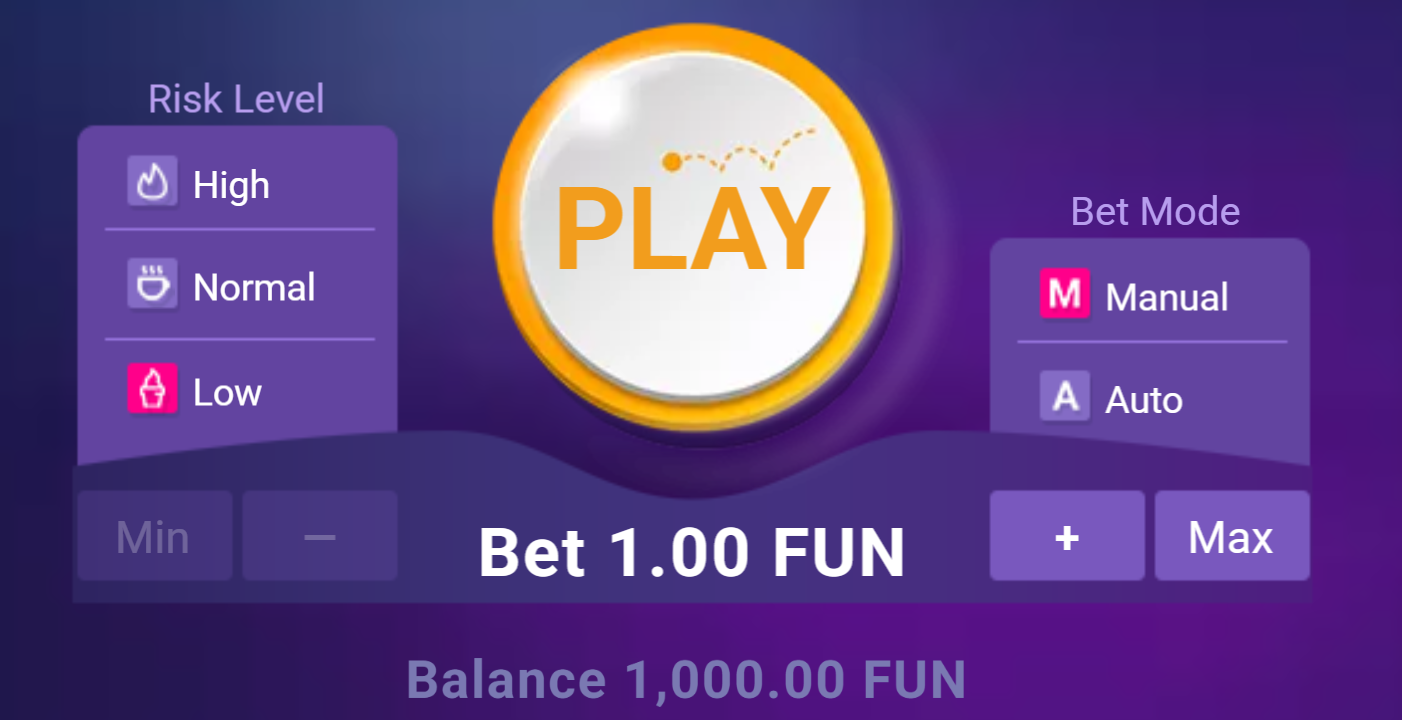
All reasoning in this guide refers to BGaming Original Plinko with 16 rows, three risk levels (Low, Normal in the interface, and High), and FUN credits only. The reference test used a fixed 1 FUN base stake, 1000 settled drops per risk level, with the first 10 preliminary drops excluded so that every system started from a clean state. The ordinary bankroll assumption is 1000 FUN and the ordinary stake cap is 100 FUN, which mirrors the limits most players will actually meet. You can inspect the exact configuration on the game settings and risk levels page.
The geometry of the board drives everything else. With 16 rows, the chance of hitting one specific outer edge pocket is 1 in 65536, and the chance of hitting either edge is 1 in 32768. For comparison, with 12 rows either edge is 1 in 2048, and with 8 rows it is 1 in 128. The High-risk edge pays 1000x, which sounds enormous until you weigh it against that 1 in 32768 frequency. The probability of seeing at least one edge hit in N drops is 1 minus (1 minus p) to the power of N. So even after 1000 High-risk drops, the chance of at least one edge is only about 3 percent. Waiting for the big multiplier is a plan with a very long, very expensive queue.
Small Bankrolls and Stake Caps: Where Systems Die
Polish players often ask whether a small budget is enough for stake doubling, and the arithmetic answers bluntly. With a 50 FUN bank and a 1 FUN base, uncapped Martingale demands a 32 FUN stake after five losses and a 64 FUN stake after six losses, which already exceeds the entire bank. Even capped Martingale’s 31 FUN cycle consumes 62 percent of a 50 FUN bank in five drops. On High risk, where centre hits pay 0.2x and arrive constantly, a small bank does not survive long enough for any recovery logic to matter. The ordinary test assumptions of a 1000 FUN bank and a 100 FUN stake cap exist precisely because smaller configurations make progression systems untestable, not because bigger banks make them profitable.
The stake cap creates a second, quieter problem. Suppose Martingale reaches the 100 FUN cap and loses again. The system cannot double, so it either flat-bets at the cap or resets, and in both cases the recovery logic is gone; you are simply placing large flat bets after a losing streak. A cap converts Martingale into a system that takes maximum risk exactly when it is deepest in the hole. If you insist on testing progressions, do it at 1 FUN base on a bank of at least several hundred FUN, and treat the exercise as measurement, not income.
- 50 FUN bank: uncapped Martingale cannot cover the 64 FUN stake due after six consecutive losses.
- 100 FUN stake cap: progression converts into flat maximum bets after deep losses.
- Small banks should use fixed stakes or percentage staking, never doubling.
Results and evidence
The Four Pocket-Pattern Rules as Test Candidates
A separate family of ideas does not change stake size but changes when you bet big, based on recent pocket history. Four candidate rules were defined in advance. Rule A100: if the previous five pocket distances from centre follow the pattern 1 to 2, then 3 or more, then 1 to 2, then 1 to 2, then 3 or more, place one 100 FUN stake. Follow it with eight ordinary paid 1 FUN drops. Rule B50: if the previous three distances are 4 or more, then exactly 1, then exactly 1, place one 50 FUN stake followed by three ordinary paid drops. Rule B100 uses the identical trigger with a 100 FUN stake. Rule C25: if the previous sixteen pockets contain at most one exact centre hit, place one 25 FUN stake followed by three ordinary paid drops.
These rules are test candidates, not future-profit advice. Each is a hypothesis about clustering in recent outcomes, and each must be evaluated on fresh, previously unseen drops with a predefined sample size before any conclusion is allowed. Numeric results from such tests are presented separately in the rendered evidence module on the tested results and observed outcomes page; this article does not invent or pre-empt them. Until a rule survives out-of-sample testing, it is a pattern description, nothing more.
Five-pocket pattern · A100 · Historical replay
Chart settings: Rows: 16 · Starting bank: 1,000 FUN · Maximum stake: 100 FUN · Base stake: 1 FUN · Triggered stake: 100 FUN · Ordinary paid drops after trigger: 8 · Previous pocket distances: 1–2 / ≥3 / 1–2 / 1–2 / ≥3
What to do, in plain language: Watch for near–far–near–near–far: near is 1–2 pockets from centre, far is 3 or more. Stake 100 FUN once, then make 8 ordinary drops.
How to repeat these settings
16 rows · Risk: Normal · Starting bank: 1,000 FUN · Stake cap: 100 FUN.
- Stake 1 FUN on each drop. Look at the latest five landing positions, in order from oldest to newest.
- Near means one or two pockets from the centre. Far means at least three pockets from it. Either side counts; the centre itself is not near.
- If the order is near → far → near → near → far, stake 100 FUN in total on the NEXT drop. Otherwise keep staking 1 FUN and check the newest five again.
- After the raised bet, make 8 paid drops at 1 FUN without triggering another raised bet. Recheck the rolling five before the following drop.
Every observation costs the base stake. After a raised bet, keep recording the ordinary drops; the rolling history is not cleared. A matching pattern does not change the next ball’s probability in an independent game.
If the game does not show the landing pocket clearly, you cannot reliably reproduce a pocket-based rule from the payout history alone.
Stop if the next required stake exceeds the cap or available bank. Do not silently reduce it or add money: that changes the tested rule.
FUN is a virtual unit. To reproduce the proportions, scale every stake, bank and limit by the same factor; game minimums and rounding can prevent an exact match.
Affiliate link · check the game, rules and local availability.
Horizontal: settled bets. Vertical: net FUN after stakes. The coloured line is this replay; dashed zero means break-even. The line ends when the rule stops. Risk samples and vertical scales differ. Historical virtual-credit results, not predictions.
Three-pocket pattern · B50 · Historical replay
Chart settings: Rows: 16 · Starting bank: 1,000 FUN · Maximum stake: 100 FUN · Base stake: 1 FUN · Triggered stake: 50 FUN · Ordinary paid drops after trigger: 3 · Previous pocket distances: ≥4 / 1 / 1
What to do, in plain language: If the last three drops land at least 4 pockets from centre, then exactly 1 pocket away twice, stake 50 FUN once. Then make 3 ordinary drops.
How to repeat these settings
16 rows · Risk: Normal · Starting bank: 1,000 FUN · Stake cap: 100 FUN.
- Stake 1 FUN for every observation. Read the last three landing positions from oldest to newest.
- The first must be at least four pockets from the centre. The next two must each be exactly one pocket from the centre; either side qualifies.
- If all three match, stake 50 FUN in total on the NEXT drop. Otherwise continue at 1 FUN, checking the newest three before each drop.
- After the raised bet, make 3 paid drops at 1 FUN, then recheck the latest three. A win or loss on the raised bet does not change this waiting period.
Every observation costs the base stake. After a raised bet, keep recording the ordinary drops; the rolling history is not cleared. A matching pattern does not change the next ball’s probability in an independent game.
If the game does not show the landing pocket clearly, you cannot reliably reproduce a pocket-based rule from the payout history alone.
Stop if the next required stake exceeds the cap or available bank. Do not silently reduce it or add money: that changes the tested rule.
FUN is a virtual unit. To reproduce the proportions, scale every stake, bank and limit by the same factor; game minimums and rounding can prevent an exact match.
Affiliate link · check the game, rules and local availability.
Horizontal: settled bets. Vertical: net FUN after stakes. The coloured line is this replay; dashed zero means break-even. The line ends when the rule stops. Risk samples and vertical scales differ. Historical virtual-credit results, not predictions.
Three-pocket pattern · B100 · Historical replay
Chart settings: Rows: 16 · Starting bank: 1,000 FUN · Maximum stake: 100 FUN · Base stake: 1 FUN · Triggered stake: 100 FUN · Ordinary paid drops after trigger: 3 · Previous pocket distances: ≥4 / 1 / 1
What to do, in plain language: If the last three drops land at least 4 pockets from centre, then exactly 1 pocket away twice, stake 100 FUN once. Then make 3 ordinary drops.
How to repeat these settings
16 rows · Risk: Normal · Starting bank: 1,000 FUN · Stake cap: 100 FUN.
- Stake 1 FUN on every observation. Look for three results in order: at least four pockets from the centre, then exactly one pocket from the centre, then exactly one pocket from the centre.
- Either left or right qualifies; the centre itself is not one pocket away. Two or three pockets away do not meet the first condition.
- When the three match, use 100 FUN as the total stake on the NEXT drop. Otherwise use 1 FUN and keep a rolling record of the newest three.
- After the raised bet, make 3 paid drops at 1 FUN before rechecking. Do not double again after a loss.
Every observation costs the base stake. After a raised bet, keep recording the ordinary drops; the rolling history is not cleared. A matching pattern does not change the next ball’s probability in an independent game.
If the game does not show the landing pocket clearly, you cannot reliably reproduce a pocket-based rule from the payout history alone.
Stop if the next required stake exceeds the cap or available bank. Do not silently reduce it or add money: that changes the tested rule.
FUN is a virtual unit. To reproduce the proportions, scale every stake, bank and limit by the same factor; game minimums and rounding can prevent an exact match.
Affiliate link · check the game, rules and local availability.
Horizontal: settled bets. Vertical: net FUN after stakes. The coloured line is this replay; dashed zero means break-even. The line ends when the rule stops. Risk samples and vertical scales differ. Historical virtual-credit results, not predictions.
Centre-count pattern · C25 · Historical replay
Chart settings: Rows: 16 · Starting bank: 1,000 FUN · Maximum stake: 100 FUN · Base stake: 1 FUN · Triggered stake: 25 FUN · Ordinary paid drops after trigger: 3 · Previous drops: 16; At most one centre hit
What to do, in plain language: Count centre hits in the last 16 paid drops. With 0 or 1 hit, stake 25 FUN once; then make 3 ordinary drops.
How to repeat these settings
16 rows · Risk: Normal · Starting bank: 1,000 FUN · Stake cap: 100 FUN.
- Use 16 rows and the risk shown above. Stake 1 FUN on each of the first 16 drops and note the landing pockets.
- Before the next drop, count hits in the single centre pocket during the latest 16 drops. If there are 0 or 1, stake 25 FUN in total on that next drop. If there are 2 or more, stake 1 FUN and check the newest 16 again next time.
- After a raised bet, make 3 paid drops at 1 FUN. Do not trigger another raised bet during those drops, whether the raised bet won or lost.
- Before the following drop, recheck the latest 16 results, including the raised bet and ordinary drops. Do not clear the history or wait for 16 entirely new drops.
Every observation costs the base stake. After a raised bet, keep recording the ordinary drops; the rolling history is not cleared. A matching pattern does not change the next ball’s probability in an independent game.
If the game does not show the landing pocket clearly, you cannot reliably reproduce a pocket-based rule from the payout history alone.
Stop if the next required stake exceeds the cap or available bank. Do not silently reduce it or add money: that changes the tested rule.
FUN is a virtual unit. To reproduce the proportions, scale every stake, bank and limit by the same factor; game minimums and rounding can prevent an exact match.
Affiliate link · check the game, rules and local availability.
Horizontal: settled bets. Vertical: net FUN after stakes. The coloured line is this replay; dashed zero means break-even. The line ends when the rule stops. Risk samples and vertical scales differ. Historical virtual-credit results, not predictions.
Why a Historical Fit Is Not a Prediction
In Plinko research, a rule that fitted old data may fail on new data. Given enough freedom, you can always find some pattern in a finished sample: with hundreds of possible trigger shapes, a few will look profitable on any given 1000-drop history by pure chance. This is why a proper parameter search must end with a held-out suffix: you search for candidate rules on the first part of the data, freeze the rule completely, and then evaluate it once on the untouched final segment. A rule that was tuned and judged on the same drops proves nothing.
Each drop of a Plinko ball is independent of the previous drops. The board has no memory, so a run of centre hits neither causes nor prevents the next centre hit, and a long absence of edge hits does not make an edge due. The waiting-time formula, 1 minus (1 minus p) to the power of N, tells you the chance of seeing a rare pocket within N future drops, and it never changes based on what already happened. A historical fit can be a useful hypothesis generator; it becomes evidence only when it survives frozen, out-of-sample testing, and even then it describes an observed sample rather than guaranteeing anything.
Next steps
An Actionable Workflow for Comparing Systems
To compare the ten systems fairly, run them under identical conditions and let the numbers speak. The workflow used in this project, which you can reproduce, is: fix the game at 16 rows; choose one risk level; set a 1 FUN base stake, a 1000 FUN bank and a 100 FUN stake cap. Then settle exactly 1000 drops per system per risk level, with every drop paid and none skipped. Record four numbers for every run: final bank, largest single drawdown, number of stop-limit triggers at minus or plus 20 FUN, and the count of partial losses (payouts above zero but below stake). That last metric exposes systems that look active while quietly bleeding.
Then rank the systems on drawdown first and final bank second. A system that ends slightly ahead but passed through a 400 FUN drawdown is worse for a real player than one that ended flat with a 60 FUN drawdown. The deep drawdown would have triggered stop limits or emptied a smaller bank. Repeat the whole comparison across Low, Normal and High risk, because a system that is tolerable on Low (0.5x centre) can be unplayable on High (0.2x centre). Finally, rerun any promising pattern rule on fresh data before trusting it. The interactive Plinko simulator lets you compress this process, and the full comparison results page shows how the systems behaved under these exact conditions.
- Step 1: fix rows, risk, base stake, bank and cap before any drop.
- Step 2: settle 1000 drops per system; log final bank, drawdown, stops, partial losses.
- Step 3: rank by drawdown, then by final bank, across all three risk levels.
- Step 4: retest any pattern-based idea on held-out fresh drops only.
A Note for Players in Poland
Poland’s finance ministry states that online casino games fall under the state monopoly, and a foreign casino licence is not Polish authorisation. Polish public discussions have also described misleading Plinko app advertisements and fake celebrity endorsements; those allegations are not independently proven operator findings, but they are a strong reason to treat any app promising guaranteed Plinko winnings with suspicion. This guide analyses strategy mathematics only and does not present any route as a licensed Polish Plinko offer.
The Bottom Line on Winning at Plinko
No betting system changes the expected value of a Plinko drop; systems only reshape how losses and wins arrive over time. Fixed and percentage stakes are measurement tools. Martingale variants are accelerators that Plinko’s partial payouts break. D’Alembert and Fibonacci trade speed for survivability. Paroli and 1-3-2-6 concentrate exposure into rare win streaks. A stop limit ends new bets after a settled threshold is reached, which can include an overshoot. Immediate restart resets only the session counter and continues spending the remaining bank; it does not protect or refill that bank. Count net results, respect the 1 in 32768 edge odds, test every pattern on fresh data, and decide your stop point before the first drop. Start from the main Plinko guide if you want the full map of settings, odds and tested outcomes.

Plinko questions answered
Can any Plinko strategy guarantee a profit?
No. Every betting system reshapes the timing of wins and losses but leaves the expected value of each drop unchanged. Partial payouts below the stake mean even frequent returns are usually losses, so no progression can promise profitability.
Why does Martingale fail in Plinko specifically?
Martingale assumes a win recovers all prior losses, but Plinko centre pockets pay only 0.2x to 0.5x the stake. A doubled bet can still return less than the previous loss, so doubling accelerates losses instead of recovering them.
Is a small budget enough for stake doubling?
No. With a 50 FUN bank and 1 FUN base, Martingale needs a 64 FUN stake by the sixth consecutive loss, which already exceeds the bank. Small budgets suit fixed or percentage stakes only.
What is the difference between a payout and a profit in Plinko?
A payout is any credit returned; a profit is a payout above your stake. Landing the Normal centre pocket on a 10 FUN stake pays 3 FUN, which is a payout but a 7 FUN net loss.
Do recent pocket patterns predict the next drop?
No. Each drop is independent, so past pockets do not influence future ones. Pattern rules are test candidates that must prove themselves on fresh, held-out data before they mean anything at all.
How often does the 1000x edge pocket hit on 16 rows?
Either edge pocket has a probability of 1 in 32768 per drop. Even across 1000 drops, the chance of seeing at least one edge hit is only about 3 percent.
How do you win Plinko every time?
No tested rule guarantees a profit on every drop or session. A sub-1× payout is a loss even when the game returns some credits. Compare full historical curves and the losing runs in our strategy results, rather than only successful screenshots.