Rows and risk
What Each Plinko Setting Actually Controls
In BGaming Original Plinko, three inputs define every drop: the number of rows (8 to 16), the risk level (Low, Normal or High), and the stake. Rows set how many peg rows the ball crosses, which fixes the shape of the landing distribution. Risk swaps the payout strip attached to that shape. The stake scales everything linearly. Nothing else is adjustable, and no setting changes the physics of the ball itself.
The most misunderstood point is the relationship between rows and risk. With a fixed row count, the probability of landing in any given pocket is fixed too. Switching from Low to High risk does not move the ball toward the edges; it re-prices the pockets. The centre pockets pay less and the edge pockets pay more, while the chance of reaching an edge stays exactly the same. At 16 rows, one specific edge pocket has a probability of 1 in 65536, and either edge together is 1 in 32768. Those numbers hold whether the strip pays 1000x or a modest multiple at the edge.
This means settings selection is really payout-strip selection. You are choosing how the same random outcomes are converted into credits, and the right choice depends entirely on what you are trying to measure or experience.
Row Count: 8 to 16 and the Shape of Outcomes
Rows determine how spread out the landing pockets are. With 8 rows, the distribution is compressed: either edge pocket together has a probability of 1 in 128, so edge hits are rare but imaginable within a short session. With 12 rows, either edge is 1 in 2048. With 16 rows, either edge is 1 in 32768, which means a player could drop thousands of balls without ever seeing the far corner.
More rows also mean more pockets and a steeper payout strip. The centre stays the most likely landing zone at every row count. However, at 16 rows the centre is relatively less dominant than at 8, and the strip can offer much larger edge multipliers because the edges are so much harder to reach. The 1000x top multiplier at High risk exists at 16 rows precisely because the underlying probability is tiny.
A practical way to choose: if your goal involves ever seeing a large multiplier within a realistic number of drops, fewer rows make that exposure more frequent. If your goal is studying long-tail behaviour or you simply accept that edge hits may never occur in your sample, 16 rows is the honest configuration. Changing rows changes probabilities; changing risk does not. That asymmetry should drive your testing plan.
Low, Normal and High: Same Ball, Different Prices
The three risk levels re-label the same landing distribution with different multipliers. The supplied figures make this concrete at the centre pocket: Low risk pays 0.5x at the centre, Normal pays 0.3x, and High pays 0.2x. Meanwhile High risk offers the 1000x edge multiplier that the lower strips do not. So High risk is not a different game; it is the same game where common outcomes pay less and rare outcomes pay far more.
Partial returns are the key consequence. On every risk level, the most likely results pay back less than the stake. A 1 FUN stake returning 0.5 FUN is a loss of half a credit, even though the ball landed safely in the middle. On High risk, the typical drop returns 0.2x, meaning the bank drains quickly between rare large hits. On Low risk, the drain is slower but the ceiling is lower.
Choosing a risk level is therefore choosing a drawdown profile. Low smooths the curve, Normal sits between, and High concentrates almost all of the return into events you may never observe in a short session. None of them changes where the ball lands, and none of them can promise a positive balance.
Stakes and controls
Input Order: Set Rows and Risk Before the Stake
The order in which you set inputs matters for clean testing. Rows and risk define the paytable; the stake merely scales it. The correct sequence is: choose rows, choose risk, read the strip, then set the stake as the final step before dropping. If you adjust the stake first and then change risk, it is easy to lose track of which paytable a given result belongs to.
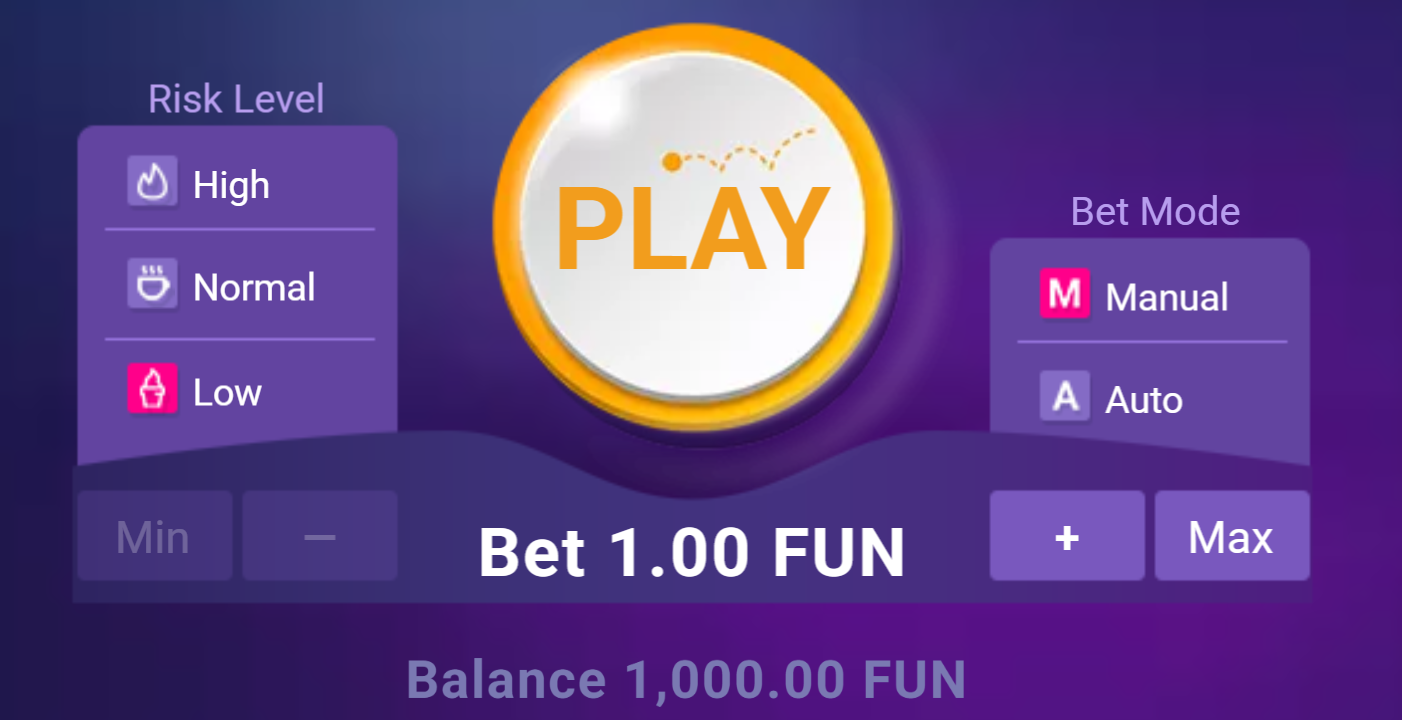
This matters most when comparing configurations. Suppose you run 100 drops at 16 rows Normal with a 1 FUN stake, then switch to High and keep dropping. If you also changed the stake mid-way, your two samples are contaminated by two variables at once. Lock rows and risk, lock the stake, run the sample, record it, and only then change exactly one thing.
On both desktop and mobile the controls are independent, so nothing enforces this order for you. The discipline has to come from your process. A simple written log with columns for rows, risk, stake, drop number and settled result is enough to keep samples clean.
Desktop and Mobile Control Walkthrough
On desktop, the row selector and risk selector sit beside the board, typically as labelled buttons or a small dropdown, and the stake field sits near the drop button. The payout strip is visible along the bottom of the board at all times. The workflow is: set rows, watch the strip update, set risk, watch the strip update again, type the stake, then drop. Because the strip redraws instantly, you can verify the paytable before every single drop.
On mobile, the same controls are usually collapsed into a settings panel to keep the board visible. Open the panel, set rows and risk, close it, and confirm the strip on the board matches what you intended before staking. The extra step of opening and closing the panel makes it easier to forget which configuration is active, so the written log becomes more important on a phone than on a desktop.
In both cases the demo or FUN mode is the right environment for settings research, because the recorded credits remain FUN and you can run large samples without financial exposure. The demo mode and the Plinko simulator both let you rehearse the exact input order described above until it is automatic.
Bankroll and limits
Reading the Payout Strip Before You Drop
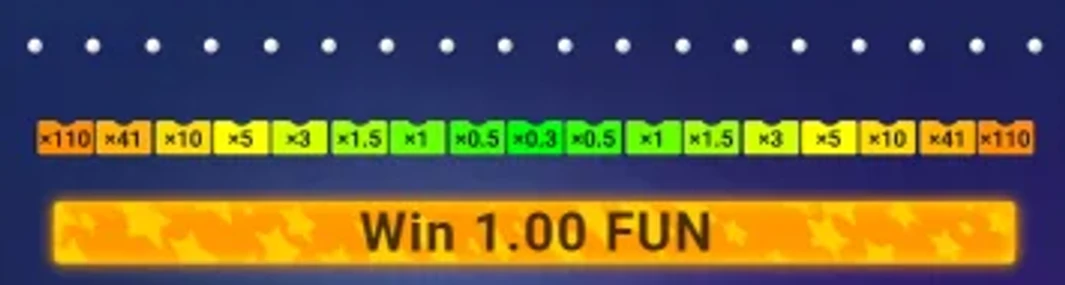
The payout strip under the board is the single most informative element on the screen, and it should be read before every configuration change. Each pocket shows its multiplier for the current row count and risk level. Count the pockets, note the centre value, note the edge value, and ask a simple question: what fraction of the strip pays below 1x?
On every risk level, the most probable outcomes pay below the stake, even though most pockets on the strip are priced at 1x or above. That is the mathematical engine of the game. On the 16-row Normal strip, the centre pays 0.3x and the near-centre pockets pay 0.5x, so the most likely single results are all partial returns. Profit requires landing outside the central cluster, and the further out the profitable pockets sit, the rarer profit becomes.
A useful habit is to write the strip down when you change settings. If you later compare sessions and the results differ, you need to know whether the strip differed too. Players who skip this step often attribute differences to luck or to a strategy when the real cause is that they were effectively playing a different paytable.
Partial Returns and Why Recovery Assumptions Break
Partial returns are the reason most staking systems misbehave on Plinko. Classic progressions assume a loss returns zero and a win roughly doubles the stake. Plinko violates both assumptions constantly: most losses return part of the stake, and most wins return far more or far less than double.
Take Martingale. The rule is to double after a loss and reset after a profitable result, with loss defined as any payout below the stake and break-even results holding the progression unchanged. A 0.5x return counts as a loss and triggers a double, even though half the stake came back. The 2x recovery assumption is invalid because the next win might pay 0.3x at the centre, which is still a loss and triggers another double. A capped Martingale permitting four doublings, with stakes of 1, 2, 4, 8 and 16 FUN, resets after a fifth consecutive loss. It does not cap your losses, it caps the number of doublings, and the reset still locks in whatever was lost. Those five bets expose 31 FUN in stakes before any returns, not 15.

Other systems have their own frictions. D’Alembert adds or subtracts one unit after a loss or profit, never below the base. Fibonacci advances after a loss and steps back two after a profit. Paroli doubles after wins and resets after three winning steps or any loss. The 1-3-2-6 sequence progresses after wins and resets after a loss. Percentage staking starts at 1% of the bank, so at a 1000 FUN bank the first stake is 10 FUN, not 1. Every one of these reacts to the partial-return definition of loss and profit, so each must be tested on Plinko’s actual strip rather than on assumptions imported from even-money games.
Choosing a Measurable Goal Before Touching Settings
Settings only make sense relative to a goal, and the goal must be something you can count. Three legitimate examples: maximising the frequency of positive drops, minimising the deepest drawdown over a fixed sample, or gaining exposure to rare high multipliers. Each goal points to a different configuration, and none of them is a promise of profit.
Frequent positive drops points toward Low risk, where the recorded 16-row strip prices 14 of 17 pockets at or above 1x and about 45% of drops return more than the stake. Fewer rows plausibly raise that frequency further, though their exact strips should be read on screen rather than assumed. Lower drawdown points toward Low risk and flat or percentage staking, accepting a low ceiling in exchange for a shallower equity curve. Rare payout exposure points toward 16 rows and High risk, accepting that the 1000x event has a probability of roughly 1 in 32768 for either edge and may simply never occur in your sample. The probability of at least one edge hit in N drops is 1 minus (1 minus p) to the power N, which you can compute before committing.
Write the goal down with a number attached: for example, at least 40 profitable drops out of 100, or a maximum drawdown below 200 FUN over 500 drops. Then the settings question becomes answerable: did this configuration meet the target in the recorded sample? Without the written target, every session feels ambiguous and every configuration looks equally plausible.
Concrete Configuration Examples
Example one, frequent positive drops: 8 rows, Low risk, flat 1 FUN stake over 200 drops. Either edge is 1 in 128, so a modest number of larger hits is plausible. The exact 8-row strip was not recorded in this study, so read it on screen before testing. For reference, the recorded 16-row Low strip pays 0.5x at the centre, prices 14 of its 17 pockets at or above 1x, and produced profitable drops about 45% of the time. The measurable target might be at least 45% of drops returning above stake. The expected weakness is a low ceiling: even good sessions produce small multiples.
Example two, lower drawdown: 16 rows, Low risk, percentage staking at 1% of a 1000 FUN bank, so the first stake is 10 FUN and it floats with the balance. The target is keeping the worst point of the curve above 800 FUN over 500 drops. The trade-off is that percentage staking at this bank size stakes far more than a 1 FUN flat test, so the two approaches are not comparable without recording which one produced which curve.
Example three, rare payout exposure: 16 rows, High risk, flat 1 FUN stake, with the explicit acceptance that either edge is 1 in 32768 and the centre pays only 0.2x. The target is not profit but observation: how many drops until any pocket beyond a chosen multiplier is hit, if at all. Over a 1000-drop sample, the honest expectation is that the top multiplier will not appear. Writing that expectation down in advance prevents the session from being misread as a failure of settings rather than a property of the paytable.
How can you avoid overspending while testing Plinko strategies?
Set the total amount you can afford to lose before the session, including every possible restart. In a hypothetical 100-credit budget, five separate 20-credit allowances still expose 100 credits. Resetting the session counter after each loss does not restore the money. Keep one cumulative balance alongside the session balance.

For a clearer demo comparison, use a fixed stake, place one drop at a time and stop at the first of your time, drop-count or loss limits. Wait for all accepted drops to settle. A stop-loss checked after a result may overshoot its threshold; it cannot cancel stakes already accepted. The simulator’s stop controls apply to the model, not to an external casino account.
A 1% stake from a 1,000-credit starting bank is 10 credits. A lower percentage reduces the amount exposed per drop; it does not improve the probability of the next pocket. Use the bankroll simulator to compare drawdown and completed bets before choosing a practice configuration.
Compare and test
Incorrect Versions and Table Reuse
A recurring problem in Plinko research is mixing data across versions or reusing a payout table from a different configuration. A strip copied from a 12-row Normal board does not describe a 16-row High board, even if the game looks identical. If a log or a screenshot does not record rows and risk alongside results, the data cannot be interpreted and should not be merged with anything else.
The same applies to strategy records. A Martingale log produced on Low risk, where the centre pays 0.5x, will behave differently from the same rule on High risk, where the centre pays 0.2x. The reason is that the definition of a loss triggers far more often on the harsher strip. Combining the two logs into one average produces a number that describes neither configuration.
The fix is boring but effective: every recorded drop carries its full context, meaning rows, risk, stake, rule state and settled result. If any field is missing, the drop is excluded from analysis. This is the same discipline behind excluding preliminary drops from a sample: the first drops of a session often run under unverified settings, and treating them as data contaminates everything downstream.
Testing One Change at a Time
The only reliable way to learn what a setting does is to change exactly one variable per sample. A clean test looks like this: 16 rows, Normal risk, 1 FUN flat stake, 1000 drops, recorded. Then one change, for example risk to High, everything else identical, another 1000 drops. Now any difference in the results is attributable to the risk level, because nothing else moved.
Contrast that with the common mistake of changing rows, risk and stake together because the new configuration feels promising. If the second sample looks better, you cannot know whether rows, risk or stake caused it. If it looks worse, you cannot know what to revert. The session produced entertainment but no information.
Stop rules and restarts need the same care. Stop limits that check settled net against minus 20 or plus 20 can overshoot, because the check happens after a drop settles, so a single result can push past the line. A restart after hitting a stop resets only the cycle reference; it keeps the remaining bank and every subsequent drop is still paid. If you treat a restart as a fresh bankroll in your log, your drawdown figures will be wrong. Record restarts as continuations, and compare cycles only within the same configuration.
Frozen Patterns, Fresh Data and Waiting Times
Pattern-based triggers are a popular hypothesis. For example, staking 100 FUN once when the previous five pocket distances alternate between short and long, then returning to eight ordinary 1 FUN drops. Or staking 50 or 100 FUN after three long distances followed by two exact ones. Or staking 25 FUN when the previous sixteen pockets contain at most one exact centre. These are testable rules, but they must be frozen in advance and evaluated on fresh data, not on the same history that suggested them.
The reason is selection. Any random sequence contains apparent patterns, and a rule fitted to past pockets will look better on that past than on the future. Freezing the rule, then running it on a new sample, is the minimum standard. Stronger still is a parameter search on one portion of data with a held-out suffix reserved for final evaluation, so the rule never touches the data used to judge it.

Waiting-time arithmetic keeps expectations honest. With either 16-row edge at 1 in 32768, the chance of at least one edge hit in 1000 drops is 1 minus (1 minus 1/32768) to the power 1000, which is small. A pattern trigger that requires rare pocket sequences inherits those waiting times. If the trigger condition itself is rare, most of a session is spent in ordinary 1 FUN drops, and the log should be analysed with that structure in mind rather than as a uniform sample.
A Note for Players in Poland
Poland’s finance ministry states that online casino games fall under the state monopoly, and a foreign casino licence is not Polish authorisation. Polish public discussions have also described misleading Plinko app advertisements and fake celebrity endorsements; those allegations are not independently proven operator findings, but they are a good reason to treat any app promising guaranteed payouts with scepticism. This guide covers settings in FUN demo play only, and nothing here is a recommendation of a licensed Polish real-money offer.
Putting the Settings Process Together
A complete settings session has five steps. First, write the measurable goal. Second, choose rows and risk that plausibly serve it, and read the strip to confirm the paytable. Third, set the stake last and lock it. Fourth, run a fixed sample, recording every drop with full context and excluding preliminary unverified drops. Fifth, change exactly one variable and repeat.
Over several cycles this builds a personal evidence base that is far more useful than any generic advice, because it reflects the actual strips you played and the actual rules you followed. The settings reference, odds and probability notes and recorded results module on this site are designed to slot into that process, and the main Plinko guide ties the strategy topics together.
The closing principle is the one that started this guide: at a fixed row count, risk changes payouts, not probabilities. Once that is internalised, settings become a deliberate choice of which paytable you want to measure yourself against.
Do the best Plinko settings on Stake or 1xBet apply here?
An operator name is not a payout table. Stake Originals Plinko and BGaming Original Plinko are different products. A search for ‘how to win Plinko in 1xBet’ also does not identify which provider, table or build is being played. Our 3,000-drop sample does not test either operator’s cash account or every game in its lobby.
Before comparing settings, match the provider, row count, risk level and every pocket multiplier. At 16 rows, the BGaming high-risk table used here pays 0.2× in the centre. A 5-credit drop there returns 1 credit and loses 4. If another board has a different centre return, the same loss progression produces different balances. Use the BGaming practice demo to identify this version; do not label these results as a tested Stake or 1xBet strategy.
Reddit strategies
Best Plinko strategy on Reddit: which claims are worth testing?
The discussions we read contain competing suggestions, not an agreed winning system. One r/stakeus post raises the stake after roughly 25 returns of 0.2× in 30 drops. Other comments favour bursts of 5–8 balls, seed changes or particular times of the hour. These are player reports. A memorable winning session does not establish which part of the routine caused the result.
Separate the proposal into a trigger, stake, reset and stopping rule. “Raise after many low returns” is too vague to reproduce. Write down exactly how many previous drops count and when the higher stake ends. Then compare every completed bet with a fixed-stake replay on the same sequence. Our historical results and strategy curves provide that comparison for the rules we actually tested; they are not a test of every Reddit claim.
The thread claiming a million Plinko drops is also a useful reminder to inspect the evidence behind a large sample count. Replies question its reporting. We have not independently verified that experiment and do not use its casino ranking as a measured result. A useful comparison needs identifiable game versions, full ordered results, stakes and a reproducible calculation—not just a headline sample size.
For the concrete calculations, see tap bursts, stake increases and seed claims. For physical-board advice about aiming at the centre, use the version and controls guide. A release position on a television board is not a steering control in this browser demo.
Do bursts of 5–8 Plinko balls change the result?
A comment in the Plinko strategy discussion proposes 16 rows, high risk and short bursts at 0.44 or 0.88 per ball. It also changes seeds and switches games. That bundles several decisions together, so a reported win cannot tell us whether the tapping rhythm helped.
The immediate calculation is exposure: five accepted bets at 0.44 commit 2.20 credits; eight at 0.88 commit 7.04. Those stakes remain at risk while the balls settle. A pause can help you see the balance and avoid sending another batch accidentally. It is not evidence that the next pocket becomes more favourable.
Replaying an unchanged result sequence with the same stakes gives the same net total whether you display it in groups of five or eight. That is an accounting fact, not a live experiment on the provider’s timing. To compare pacing itself, you would need a separate recorded test, a fixed protocol and all accepted bets. Our current corpus does not establish a timing advantage.
Raise the stake after 25 low returns: what is the actual rule?
One player describes increasing from 0.25 to 0.50 after about 25 results of 0.2× in about 30 drops. Later stake changes and resets are described less precisely. We have not reproduced that player’s account or verified the reported profit. A repeatable adaptation would have to specify an exact lookback, threshold, higher stake and reset before testing.
At 0.2×, a 0.25-credit stake returns 0.05 and loses 0.20. A 0.50-credit stake returns 0.10 and loses 0.40. The increase doubles both the possible payout and the amount lost on that outcome. It does not itself change the next pocket’s probability. In an independent-drop model, a run of low returns does not make a higher return due.
A useful test keeps the fixed-stake comparison, every losing interval and any bankroll stop. Our tested historical strategies include positive examples with their complete drawdowns. A profit found after inspecting a sequence is a reason to test the frozen settings on new data, not a verified forecast.
Do seed changes every 500 drops or end-of-hour bets help?
The 1,000× discussion includes suggestions to change seeds within 500 drops and play near the end of an hour. Other replies describe different routines and losses. These reports do not isolate a repeatable advantage.
In the published Stake fairness implementation, the random calculation uses server and client seeds plus a nonce and cursor. A seed change changes the sequence; it does not reveal which new sequence will be profitable. Wall-clock minute is not an input in that documented calculation. This statement concerns that implementation, not every product named Plinko.
Our BGaming sample is not a controlled trial of seed rotation or hour-of-day effects. We therefore do not label either routine as tested. For a repeatable comparison, change the stake rule while keeping the recorded results fixed; use a fresh recorded sample to evaluate a rule chosen in advance.
Plinko questions answered
Does High risk make the ball land near the edges more often?
No. At a fixed row count, landing probabilities are fixed. High risk re-prices the pockets: the centre pays less, around 0.2x, and the edges pay far more, up to 1000x at 16 rows, while the chance of reaching an edge stays 1 in 32768 for either edge.
Which settings give the most frequent profitable drops?
Low risk pays at or above 1x on 14 of the 17 recorded pockets at 16 rows, with about a 45% chance of a profitable drop. Fewer rows concentrate probability further toward the centre, which plausibly raises that frequency, though their strips should be read on screen rather than assumed. The trade-off is a low ceiling on multipliers. This is a measurable goal, not a route to guaranteed profit.
Why does Martingale behave strangely on Plinko?
Because most outcomes are partial returns. A 0.5x payout counts as a loss and triggers a double, and the next win may pay below 2x, so the classic recovery assumption fails. A four-loss cap limits doublings, not total losses.
How should I test a new configuration?
Change exactly one variable per sample. Lock rows, risk and stake, run a fixed number of drops with every result recorded, then alter one setting and repeat. Changing several things at once makes the results uninterpretable.
Is a big edge multiplier realistic in a short session?
Usually not at 16 rows. Either edge has a probability of 1 in 32768, so even 1000 drops give only a small chance of one hit, computed as 1 minus (1 minus p) to the power N. Fewer rows raise that chance substantially.