Game and version
Confirm You Are Looking at the BGaming Original Plinko
Before you use any payout table, odds chart or strategy on this site, confirm which Plinko you are actually playing. Plinko is a game family, not a single product: several studios publish their own versions with different row counts, different multiplier ladders and different risk labels. Everything here, including the worked arithmetic, the pocket probability tables and the recorded drop evidence, refers to one specific build: the BGaming Original Plinko, played with FUN demo credits. It is configured at 16 rows with three risk levels labelled Low, Normal and High.
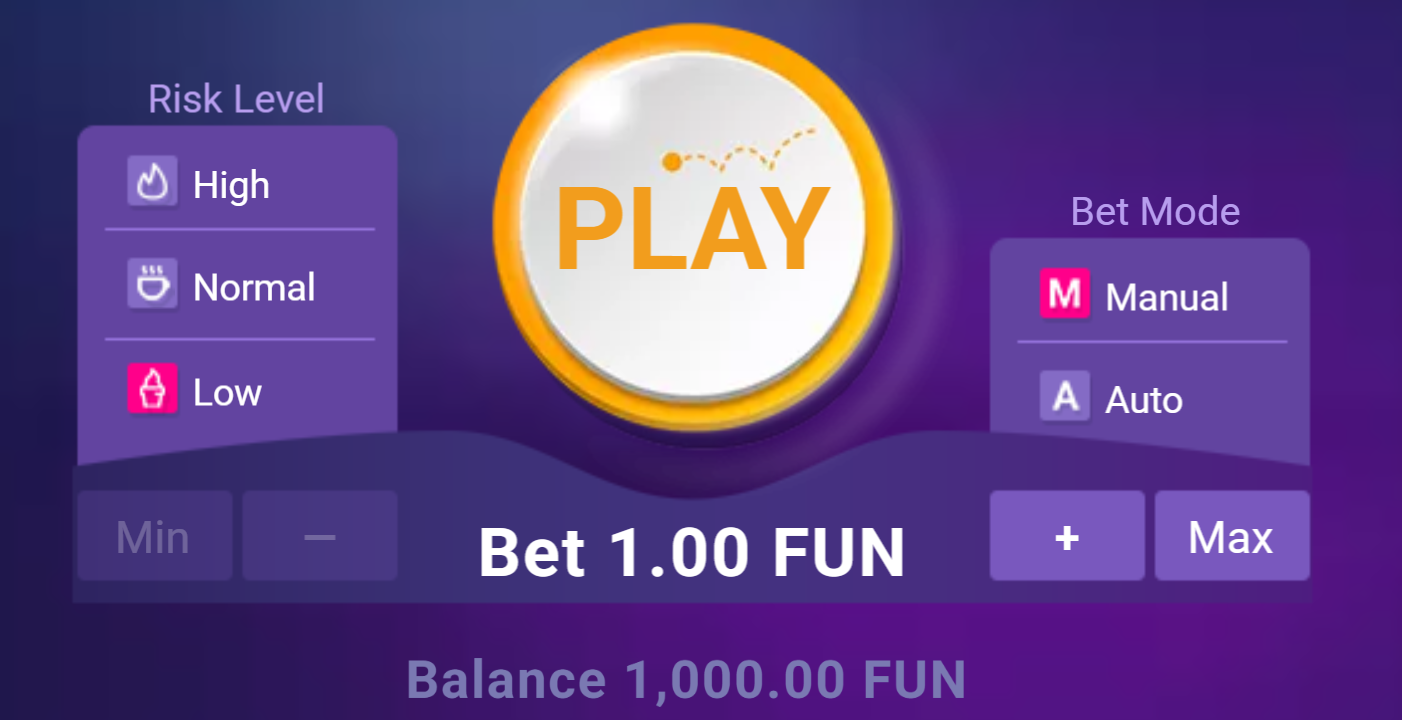
Identifying the provider is straightforward. Open the game info or help panel inside the game window and look for the studio name and the rules summary. The BGaming version shows a triangular peg board, a row selector, a risk selector, a single stake field, and Manual and Auto play buttons. If your game shows a different maximum multiplier, a different number of pockets, or risk labels that do not match Low, Normal and High, you are looking at a different build and the multiplier values quoted here will not apply. A payout table is only valid for the exact configuration it was measured or derived from, so treat version checking as step zero, not an afterthought.
One clarification that saves real confusion: this Plinko has a single stake control. Some crash-style games, such as Aviator, show two betting panels side by side so you can place two simultaneous wagers on one round. Players coming from those games sometimes hunt for a second panel here. There is none. Each drop in BGaming Plinko is one ball, one stake, one settled pocket. If you see two stake fields anywhere, you are in a different game entirely.
- Provider: BGaming Original Plinko
- Currency: FUN demo credits only
- Rows used across this site: 16
- Risk levels: Low, Normal (the UI label for medium), High
- One stake control per drop, not dual betting panels
The Board, the Pegs and the Pockets
The board is a triangle of pegs. You release a ball from the top, it bounces left or right at each peg it meets, and it lands in one of the pockets along the bottom edge. With 16 rows there are 17 pockets. The centre pockets pay the smallest multipliers and the outer edge pockets pay the largest, because the ball is far more likely to finish near the middle than at an extreme edge. That single fact drives everything else in the game.
Each peg collision is effectively a left-or-right event, so the distribution of final pockets follows a binomial shape. At 16 rows, the probability of the ball finishing in one specific outermost edge pocket is 1 in 65,536, and the probability of finishing at either edge is 1 in 32,768. The centre pockets, by contrast, absorb a large share of all drops. This is why the edge multipliers can reach 1000x on High risk while the centre pockets pay less than your stake back. The game is not hiding anything; the paytable is simply the mirror image of the geometry.
Understanding this shape matters for how you read results. A long run of centre pockets is not a cold streak or a sign the game is due to pay; it is the expected behaviour of the board. Equally, one edge hit in a short session tells you almost nothing about the next hundred drops. If you want to see the distribution for yourself, the Plinko simulator lets you run large numbers of drops quickly and watch the pocket histogram build into the familiar bell shape.
Can you win Plinko by aiming at the centre?
In a physical Plinko board, release position is a real input. In the BGaming demo used here, the controls let you choose the stake, rows and risk; they do not let you drag the ball to a chosen release point. Advice about standing in the centre on television therefore does not describe a control you can use in this game.
The centre also has a different purpose in the payout table. On our 16-row high-risk board it pays 0.2×, so a 10-credit stake returns 2 and loses 8. More centre hits would not mean more profit. Read the actual multipliers before importing a strategy from a television clip, a physics demonstration or another app.
For ‘how to win’ questions, separate a single profitable drop from a profitable complete session. A 2× return doubles the stake returned on that drop; it does not undo all previous losses. The stake and risk examples show the calculation, and the full strategy curves include the losing intervals.
Stakes and controls
Choosing the Number of Rows
The row selector changes how many peg rows the ball passes through, which changes both the number of pockets and the spread of outcomes. Fewer rows mean fewer pockets, a narrower distribution and relatively more frequent mid-range results. More rows mean more pockets, longer odds on the edges and larger top multipliers to compensate. At 8 rows the chance of hitting either edge is 1 in 128; at 12 rows it is 1 in 2,048; at 16 rows it is 1 in 32,768. The ball does not become luckier or unluckier as you add rows; the outcomes simply spread out.
All strategy testing and recorded evidence on this site uses 16 rows, and this guide assumes that setting throughout. There is a practical reason for standardising: if you compare strategies across different row counts, you cannot tell whether a difference came from the strategy or from the board configuration. When you run your own practice sessions, pick one row count and keep it fixed for the whole session so your notes mean something.
If you are brand new, 16 rows is also the most instructive setting because it shows the full character of the game. You see frequent small centre returns, occasional mid-pocket results, and edge hits rare enough that you may not see one in hundreds of drops. Whatever you choose, change rows deliberately, note the change in your worksheet, and never mid-session without recording it.
Choosing a Risk Level: Low, Normal or High
The risk selector reshapes the multiplier ladder while the board geometry stays the same. The pockets do not move; what changes is how much each pocket pays. Low risk flattens the ladder: the centre pockets return more of your stake and the edges pay modest multiples. High risk does the opposite: the centre pockets return very little and the edge pockets pay up to 1000x. Normal sits between the two and is labelled Normal in the interface, which corresponds to what many guides call medium.
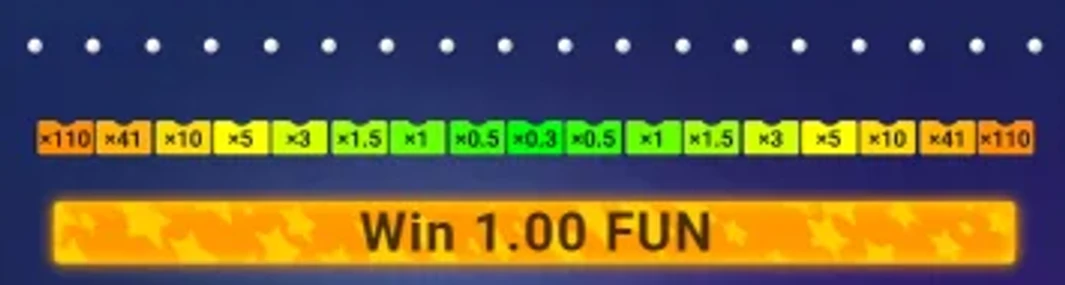
The centre pocket illustrates the difference cleanly. On Low risk the centre multiplier is 0.5x, on Normal it is 0.3x, and on High it is 0.2x. Since the centre region is where most balls land, your risk choice largely decides what a typical drop feels like. On Low, a typical drop returns half your stake. On High, a typical drop returns a fifth of your stake, and your balance depends on occasional larger hits. Same board, same probabilities, different cash-flow texture.
For a first session, Low risk is the gentlest way to learn the controls because your FUN balance moves slowly. But do not mistake Low risk for low cost: a 0.5x return is still a loss of half your stake on that drop. Every risk level is built so the centre pockets pay less than the stake, which is exactly why partial returns deserve their own section below. You can explore how each risk level behaved in recorded play on the strategy results pages, where every risk was sampled over 1,000 drops.
- Low: centre pays 0.5x, gentle balance swings, small top multipliers
- Normal (medium): centre pays 0.3x, middle-ground ladder
- High: centre pays 0.2x, edge pockets pay up to 1000x, sharp balance swings
Setting Your Stake
The stake field is the single amount you pay for each drop. In the demo environment the balance is measured in FUN credits, and the fixed-stake baseline used across this site is 1 FUN per drop. You type or adjust the amount once, and every subsequent Manual drop or Auto drop uses that amount until you change it. There is no second panel, no per-ball split and no hidden side bet: one number, one ball, one settlement.

If you want to think in real-money terms while practising, treat the arithmetic as hypothetical and do it separately from the FUN balance. For example, imagine a hypothetical stake of 2 PLN per drop purely as a mental exercise: every multiplier in the paytable would then apply to that 2 PLN figure. The game itself still records FUN, and nothing in the demo involves deposits or withdrawals. Keeping the two columns separate in your notes, FUN recorded and hypothetical PLN for intuition, prevents the common mistake of mixing units mid-calculation.
Stake sizing becomes important once you move past single drops into structured play. Flat staking keeps the amount constant. Percentage staking sets the stake as a share of your current bank, so at a 1,000 FUN bank a 1% setting stakes 10 FUN, not 1. Progression systems change the stake after each settled result. All of those are covered in the strategy and settings guides, but for your first ten drops, fix the stake at a small constant amount and do not touch it.
Placing One Drop and Identifying the Settled Pocket
A single drop has a clean sequence. Set rows, set risk, set stake, press the drop button. The stake is deducted from your balance immediately, and the ball animates down the board. When it comes to rest in a pocket, the game settles the drop on the server: the pocket multiplier is applied to your stake and the return is credited. Only then is the drop complete. The visual of the ball resting in a pocket and the credit appearing in your balance are two views of the same settled event.
Identifying the settled pocket is a skill worth practising because the pockets are labelled by multiplier, not by position number. Watch where the ball stops, then read the multiplier printed on that pocket. On a 16-row board the ladder is symmetric, so a pocket three positions left of centre pays the same as three positions right of centre. What matters for your records is the multiplier, and optionally the distance from centre, which is simply how many pockets away from the middle pocket the ball finished.
Record each drop as three numbers: stake, multiplier, returned credits. If you also note the pocket distance from centre, your worksheet becomes usable for the pattern-based strategies documented on this site, several of which trigger on sequences of recent pocket distances. That habit costs seconds per drop and turns casual play into data you can actually analyse later.
- Step 1: confirm rows and risk
- Step 2: set one stake amount
- Step 3: press drop and wait for the ball to settle
- Step 4: read the multiplier on the settled pocket
- Step 5: record stake, multiplier, return and distance from centre
Manual vs Auto: Animations vs Settled Results
Manual mode drops one ball each time you press the button. Auto mode queues a series of drops at your chosen stake and runs them back to back, usually with options for the number of drops and sometimes stop conditions. The underlying settlement is identical: every ball is an independent server-settled event with its own stake deduction and its own credited return. The mode changes the pacing, not the mathematics.
The important subtlety in Auto mode is overlapping animation. Because drops fire in quick succession, a new ball may start falling while the previous ball is still visually bouncing, and several balls can be on the board at once. It is easy to assume that what you see on screen is the current state of your balance. It is not. Your balance reflects completed server settlements, and the animations can lag or overlap behind them. A ball still mid-flight has not settled; its result is not yet in your balance even though its stake was already deducted when the drop started.
Practical consequences follow. First, never judge a streak from the visual board; judge it from the balance history or your own drop log. Second, when you stop an Auto sequence, the last few balls may still settle after you press stop, so the final balance can move once or twice more. Third, for practice purposes, Manual mode is better: it forces you to observe and record each settled pocket before the next drop, which is exactly the discipline the worksheet below requires. Auto has its place for gathering large samples quickly, and the recorded evidence on this site uses structured batches of 1,000 drops per risk, but batch play is a measurement technique, not a way to change your odds.

RTP and payouts
Calculating Stake, Returned Credits and Net: Partial Returns Explained
The most important arithmetic in Plinko is the difference between returned credits and net result. Returned credits are what the game pays back into your balance after a drop: stake multiplied by the pocket multiplier. Net result is returned credits minus stake. When the multiplier is below 1x, you get money back but still lose on the drop. This is a partial return, and it is the normal state of affairs in Plinko because the centre pockets, where most balls land, all pay below 1x.
This distinction breaks naive intuition and also breaks naive strategies. A drop that returns credits feels like something happened in your favour, and progress bars or animations can make it feel like a win, but if the return is smaller than the stake your balance went down. On this site, a loss means any payout below the stake, a profit means any payout above the stake, and an exactly 1x result is break-even. That definition matters because it is the one used to evaluate every strategy in the recorded evidence.
Partial returns are also why the classic Martingale assumption fails here. Textbook Martingale doubles after a loss on the assumption that a win pays 2x and recovers everything. In Plinko, most losses are partial returns, and many wins pay less than 2x, so doubling after a loss does not reliably recover the previous outlay. The capped Martingale variant tested on this site exists precisely because of this mismatch. Before adopting any progression, run the arithmetic on partial returns first; the odds and payout pages list the full multiplier ladders you need for that.
Worked Examples at 2 FUN per Drop
The cleanest way to internalise the arithmetic is to compute four concrete drops at a fixed 2 FUN stake. The formula never changes: returned credits equal stake times multiplier; net equals returned credits minus stake.
Example one, a 0.2x pocket, which is the centre pocket on High risk. Returned credits: 2 FUN times 0.2 equals 0.4 FUN. Net: 0.4 minus 2 equals minus 1.6 FUN. You received credits back, but the drop cost you 1.6 FUN. This is the most common single outcome on High risk and the reason balances erode steadily between rare large hits.
Example two, a 0.5x pocket, the centre on Low risk. Returned: 2 times 0.5 equals 1 FUN. Net: 1 minus 2 equals minus 1 FUN. Half your stake back, half lost. On Low risk this is your typical drop, and a session of mostly centre hits is a slow, predictable decline, not a string of bad luck.
Example three, a 1x pocket. Returned: 2 times 1 equals 2 FUN. Net: zero. Break-even. Your balance is unchanged, and under the rules used on this site a break-even holds the current step of any progression rather than advancing or resetting it. Example four, a 5x pocket. Returned: 2 times 5 equals 10 FUN. Net: 10 minus 2 equals plus 8 FUN. This is a clear profit, and in a progression system it is the kind of result that triggers a reset. Notice that a 5x hit offsets exactly five 0.2x losses of 1.6 FUN each with nothing left over; run that comparison whenever a big multiplier tempts you to raise the stake.
- 0.2x at 2 FUN: return 0.4 FUN, net minus 1.6 FUN
- 0.5x at 2 FUN: return 1 FUN, net minus 1 FUN
- 1x at 2 FUN: return 2 FUN, net 0, break-even
- 5x at 2 FUN: return 10 FUN, net plus 8 FUN
Practice and examples
Your First-Ten-Drop Practice Worksheet
Before testing any strategy, run ten deliberate Manual drops and write everything down. The goal is not to win FUN credits; it is to prove to yourself that you can execute the full loop cleanly: configure, drop, identify the pocket, compute the return, compute the net, update the balance. Ten drops is enough to surface every common beginner mistake and small enough to review line by line.
Set up as follows: 16 rows, Low risk, fixed stake of 1 FUN, Manual mode, and a starting balance you note before drop one. Use the free Plinko demo so the exercise costs nothing. After each drop, fill one row of the worksheet: drop number, stake, settled pocket multiplier, distance from centre, returned credits, net result, running balance. Compute returned credits and net by hand before checking the balance display; if your arithmetic and the game disagree, find out why before continuing.

When the ten drops are done, answer three review questions. How many drops returned less than the stake? On Low risk at 16 rows, expect most of them to be partial returns; if that surprises you, the lesson has done its job. What was your total net across all ten drops, computed as final balance minus starting balance, and does it equal the sum of your per-drop nets? It must, to the credit. Finally, what was the largest single net loss and the largest single net gain? These two numbers are your first feel for variance, and they are the quantities every staking strategy on this site is ultimately trying to manage.
Only after a clean worksheet should you graduate to structured approaches: flat staking, percentage of bank, capped Martingale with its 1, 2, 4, 8, 16 unit ladder and reset after five consecutive net losses, D’Alembert, Fibonacci, Paroli, 1-3-2-6, or stop limits at minus 20 and plus 20. Each is documented with recorded results elsewhere on the site, and each assumes you can already do what the worksheet trains.
- Configuration: 16 rows, Low risk, 1 FUN fixed stake, Manual mode
- Per drop record: stake, multiplier, distance from centre, return, net, running balance
- Review: count partial returns, reconcile total net, note largest win and loss
- Pass condition: your hand arithmetic matches the game balance on all ten drops
Where to Go Next
You now have the complete beginner loop: confirm the version, set rows and risk, set one stake, place a drop, identify the settled pocket, and compute stake, return and net including partial payouts. The natural next step is the demo game for your ten-drop worksheet. Follow it with the odds pages if you want the full multiplier ladders and edge probabilities. Then use the strategy and settings guides when you are ready to compare staking systems against recorded evidence rather than marketing claims.
Keep one expectation fixed throughout: no staking system changes the probability of any pocket, and this site does not promise winning every time or at all. What good process gives you is control: you always know your stake, your net, your exposure and your stop points. In a game where most drops return less than they cost, clear records help you track the cost of play.
Mobile play
Playing on Mobile: Controls and Layout
The BGaming Plinko interface adapts to small screens by stacking the controls, typically placing the board above and the stake, risk, rows and drop controls below or behind a collapsible panel. The tap targets replace the mouse clicks: tap to set the stake, tap the risk selector to cycle or choose, and tap the main button to drop. Auto settings usually sit behind a separate toggle so the main screen stays uncluttered.
Two mobile-specific habits are worth building. First, after changing any setting, glance back at the stake field before dropping; on compact layouts it is easy to adjust the wrong control or to carry a previous stake into a new session. Second, in Auto mode on a phone, the overlapping animation issue is amplified because more of the board is visible at once relative to the balance display. So rely on the balance figure and your log rather than the visual flow of balls.
This site makes no claims about testing on specific devices, and performance will vary with your hardware, browser and connection. If the game stutters, reduce session length rather than assuming anything about outcomes; animation quality has no relationship to settlement, which happens server-side regardless of what your screen shows.
Plinko in Poland: Context and Common Questions
Polish players should know the regulatory frame before anything else. The Polish finance ministry states that online casino games fall under the state monopoly, and a foreign casino licence is not Polish authorisation. This site does not present any route as a licensed Polish Plinko offer, does not recommend bypassing restrictions, and uses FUN demo credits precisely so you can learn the game without those questions arising. Polish public discussions also describe misleading Plinko app advertisements and fake celebrity endorsements. Those allegations are not independently proven operator findings, but they are a good reason to verify the provider and version of any Plinko you encounter, exactly as this guide’s first section describes.
The questions Polish players actually ask map well onto this guide’s content. Whether Plinko apps really pay out is, at its core, a question about returned credits versus net. A game can credit returns on most drops while your balance still falls. That is why the partial-return arithmetic above matters more than any screenshot of a big multiplier. Whether a small budget can survive stake doubling is a question the capped Martingale evidence answers directly. At a 1,000 FUN bank with a 100 FUN cap, the 1, 2, 4, 8, 16 ladder exhausts its steps quickly, and five consecutive net losses force a reset. And how to win without confusing return with profit is precisely the worksheet discipline: record every drop, compute net honestly, and let the arithmetic rather than the animations tell you how the session went.
Plinko questions answered
How do I play Plinko for the first time?
Choose 16 rows, pick a risk level, set one stake, and press the drop button. The ball settles in a pocket, and the game credits stake times the pocket multiplier. Record the multiplier and compute your net as return minus stake.
Why did I get credits back but still lose?
Most pockets pay below 1x, so a partial return is smaller than your stake. A 2 FUN drop landing on 0.5x returns 1 FUN, which is a 1 FUN net loss even though credits came back.
Does Plinko have two betting panels like Aviator?
No. BGaming Original Plinko has a single stake control. Each drop is one ball, one stake and one settled pocket.
Is Manual or Auto mode better for beginners?
Manual. It forces you to observe each settled pocket and record the result before the next drop. Auto runs batches quickly but overlapping animations can mislead you about what has actually settled.
Does doubling my stake after a loss work in Plinko?
Not reliably. Classic Martingale assumes a 2x win recovers losses, but most Plinko losses are partial returns and many wins pay under 2x. The capped variant tested here uses a 1, 2, 4, 8, 16 ladder and resets after five consecutive net losses.